1. General Introduction
1.1 Outline
OpenATC configuration software is a newly developed set of software products, mainly providing configuration, control and monitoring functions for signal machines, installed on a PC for easy use in the field.
OpenATC configuration software communicates with the signal machine through the network port or serial port to realize the functions of signal machine characteristic parameter setting, signal machine operation status monitoring, signal machine intervention control, etc. to realize the configuration and maintenance work in the daily operation of the signal machine.
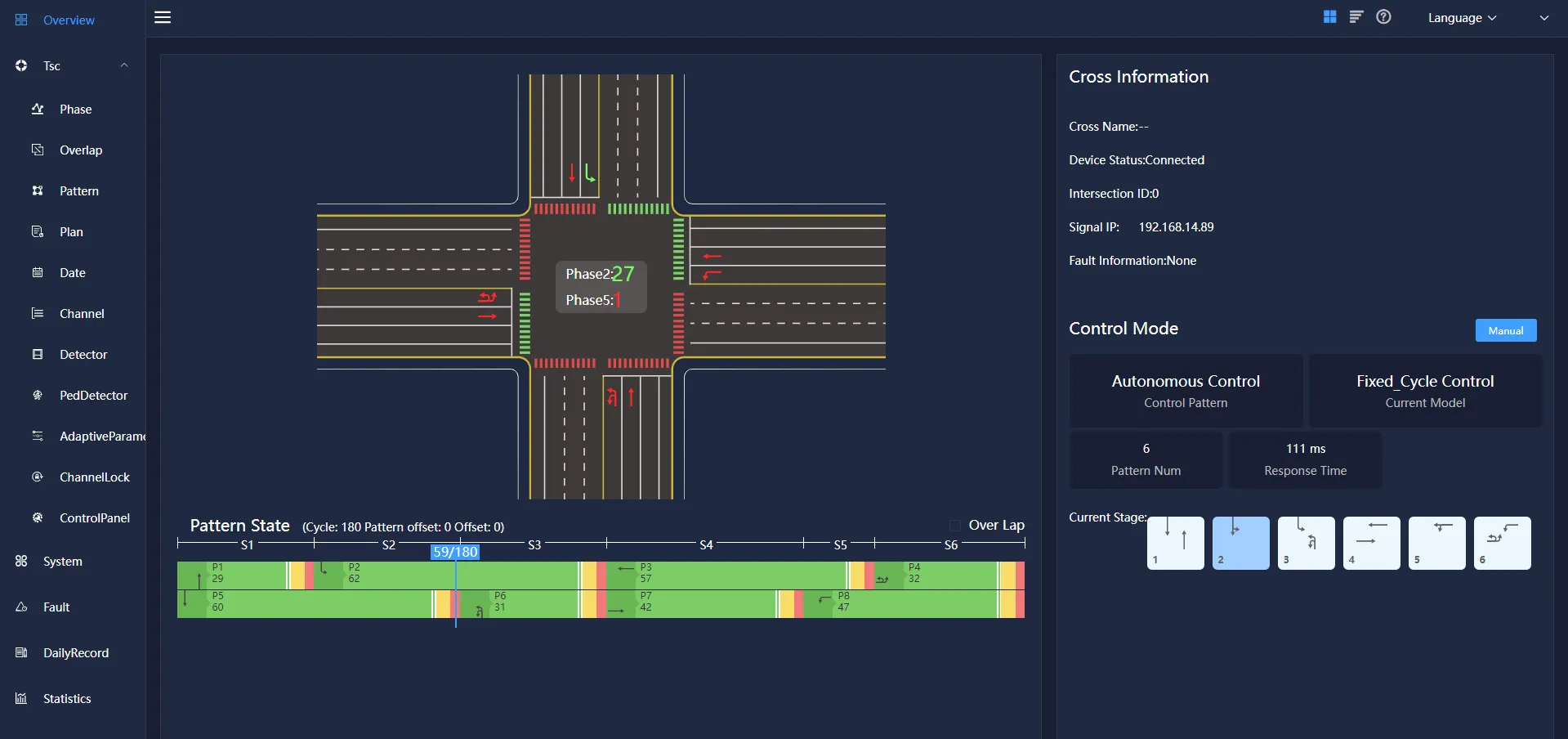
The main screen of the system client running is as follows:
1.2 Glossary of Terms
(1) control center
In a traffic signal control system, an upper-end device that can communicate with and control and monitor multiple signal machines.
(2) phase
The signal display status of one or more traffic streams that have been granted the right-of-way at the same time during a signal cycle.
(3) offset
In coordinated control, the difference between the start time of a coordinated intersection and a specified reference intersection phase or cycle, or the time difference between the start time of a coordinated intersection phase or cycle and a specified reference time.
(4) cycle
The signal light color displays the time required for a week in the set phase sequence.
(5) ring
The ring consists of two or more conflicting phases, and the phases are arranged in such a way as to ensure that they appear in a prescribed order.
(6) stage
A state in which one or more phases acquire the right-of-way simultaneously during the signal cycle.
(7) barrier
The barrier is the reference point for the phase sequence selected in a multi-loop controller. At this reference point, all rings end their release simultaneously while crossing the barrier to release the phase and signal time on the other side of the barrier. This barrier ensures that conflicting phases in different rings cannot be released at the same time.
(8) minimum green time
The minimum time for the phase to execute the green light.
(9) maximum green time
Maximum time for phase execution green light.
(10) green coflict
It is specified that the green signal of the signal group that is not allowed to be released at the same time is lit at the same time.
(11) split
The ratio of the effective green time of the signal phase to the cycle duration in one signal cycle.
(12) inter-green time
he time between the end of one phase green light time and the start of the next phase green light time.
(13) yellow time
The duration of the yellow light when the right-of-way is about to change.
(14) all red
The red light time executed at the end of the motor vehicle phase release, before the next phase release.
(15) date schedule
Signaler day plan scheduling rules.
(16) green wave
Through the distance between the intersections on the arterial road, the hourly speed of traffic to calculate the green light start time difference, adjust the timing scheme of each intersection, to achieve the effect of vehicles through these intersections, all the way to the green light, this arterial intersection coordination control, known as the green wave belt, commonly known as line control.
(17) isolated control
Single intersection road traffic signal control machine independent operation, and other intersections independent of the traffic signal control mode.
(18) arterial control
It is a traffic signal control method that coordinates the road traffic signals at two or more intersections to control them.
(19) area-wide control
The method of treating intersections within a certain area as a logical region and optimizing the scheme timing, release time and phase difference of these intersections in order to improve the efficiency of the whole area and alleviate and improve urban traffic problems.
(20) flashing yellow control
All phases of the signal machine immediately go into flashing state. All signals at road junctions are in yellow flashing state.
(21) all-red control
All phases of the signal machine immediately go to all-red status. All signal machines at road junctions are all in full red.
(22) light-off control
The signal machine immediately turns off all phase outputs. All signal lights at the intersection are all off.
(23) step control
The traffic signal control method that makes the intersection signals release in sequence by stage by issuing step-by-step instructions to the traffic signal control machine.
(24) fixed-time control
The phase signal is output at a fixed period according to a preset scheme.
(25) vehicle actuated control
The signal machine enters the inductive control mode. The signal is in induction control mode, when the phase time of the signal will increase in real time with the increase of traffic flow at the intersection.
(26) adaptive control
The road traffic signal control machine adjusts the traffic signal control method of each phase signal duration according to the traffic flow information of different phases measured by the detector, and the time duration optimization is reflected in the next cycle.
(27) cableless linking control
There is no communication link established between each road traffic signal control machine at different intersections, and the traffic signal control method of coordinating traffic signals at different intersections is achieved by setting the phase difference according to the clock for synchronization.
(28) pedestrian crossing control
A traffic signal control method that uses pedestrian crossing buttons or inductive pedestrian crossing signal control systems to control pedestrians crossing the intersection.